
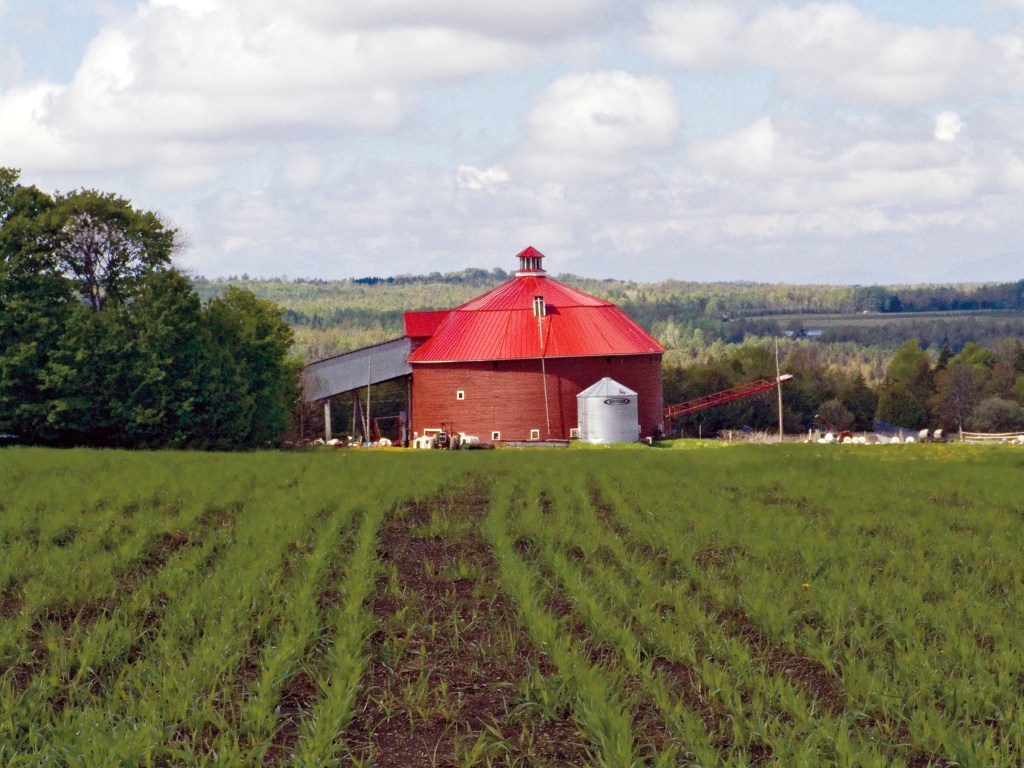
True round barns, such as the Holmes barn in Barnston West, demanded more precise engineering than polygonal models. Some architectural historians have claimed that round barns became passé because farmers could not easily expand them. Stanley Holmes, however, points out that a round barn is like the hub of a wheel, and single-storey rectangular annexes can be added like spokes: he has made one addition to his round barn. Other architectural historians have suggested that round barns were not adaptable to the use of tractors. But Stanley Holmes drives a tractor into the upper storey of his round barn. Farmers, at least in the Townships, likely stopped building round barns because they were more complex and expensive to put up and to maintain than conventional barns.
Documentaries by Louise Abbott:
THE TRUE ROUND BARN by Louise Abbott
From The Heart of the Farm published in 2008 by Price-Patterson Ltd., Montreal
In 1897 William Henry Holmes bought a farm on gently sloping terrain outside the village of Way’s Mills. Ten years later, fire swept through his property and destroyed his rectangular barn. Bucking convention, he replaced it with a round one.
Over the course of more than a century, sunlight has bleached the finish on the clapboards; wind has twisted the frame; snow and ice have weakened the roof; and fire has charred the interior silo. But the barn is still standing, still owned by the Holmes family, still sheltering cows and calves.
Indeed, for Stanley Holmes, the old building is an essential part of the dairy operation that he runs with his two sons, as well as a reminder of his ancestral history. “My grandfather brought the idea for a round barn from Massachusetts,” he recalls, as he sits in the living room of his house at Holmhurst Farm. “He’d spent time there working for his uncle in the lumber business.”
William Holmes had seen the polygonal Walbridge barn in Mystic, too. No doubt he was also aware of the round barn that Pierre Valade had constructed in 1902 in Coaticook, and the one that Thomas J. Young had raised in 1905 near Ruiter’s Corner in what is now the municipality of Ogden. The Valade barn was eighty feet in diameter. According to the Stanstead Journal of September 21, 1905, the Young barn – “the first of its kind to be built in the Township of Stanstead” – was sixty feet in diameter with twenty-four-foot posts.
The Holmes barn was smaller than the Valade barn but larger than the Young barn. On May 30, 1907, the Stanstead Journal reported: “Mr. W. H. Holmes commenced the foundation to his barn this week. He intends putting up a round barn with a diameter of 70 feet.” On July 25 the newspaper noted: “Mr. Wm. Holmes expects to have his fine new barn ready for storing his hay next week.”
Shortly afterwards, the Holmes family held a celebration to inaugurate the building. In the August 1 edition of the Journal, the correspondent enthused about the “big crowd at the ‘Holmes barn social’ at Way’s Mills. They all report a fine time.”
The Holmes barn has been in agricultural service ever since. “It’s the only round barn that I know of in Quebec that’s still in the same family that built it.” Stanley Holmes points out.
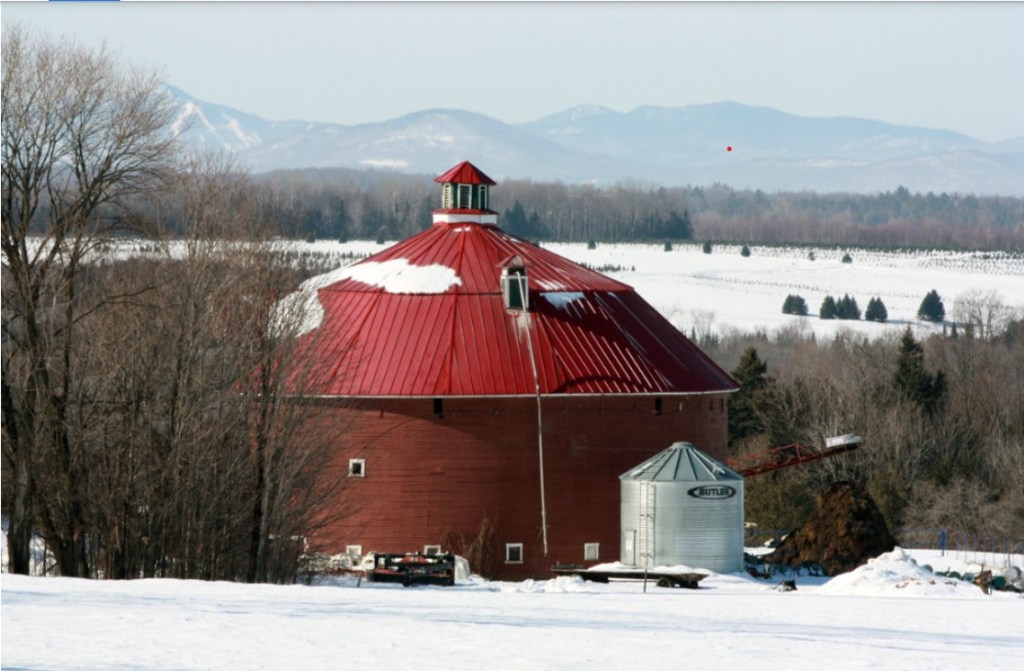
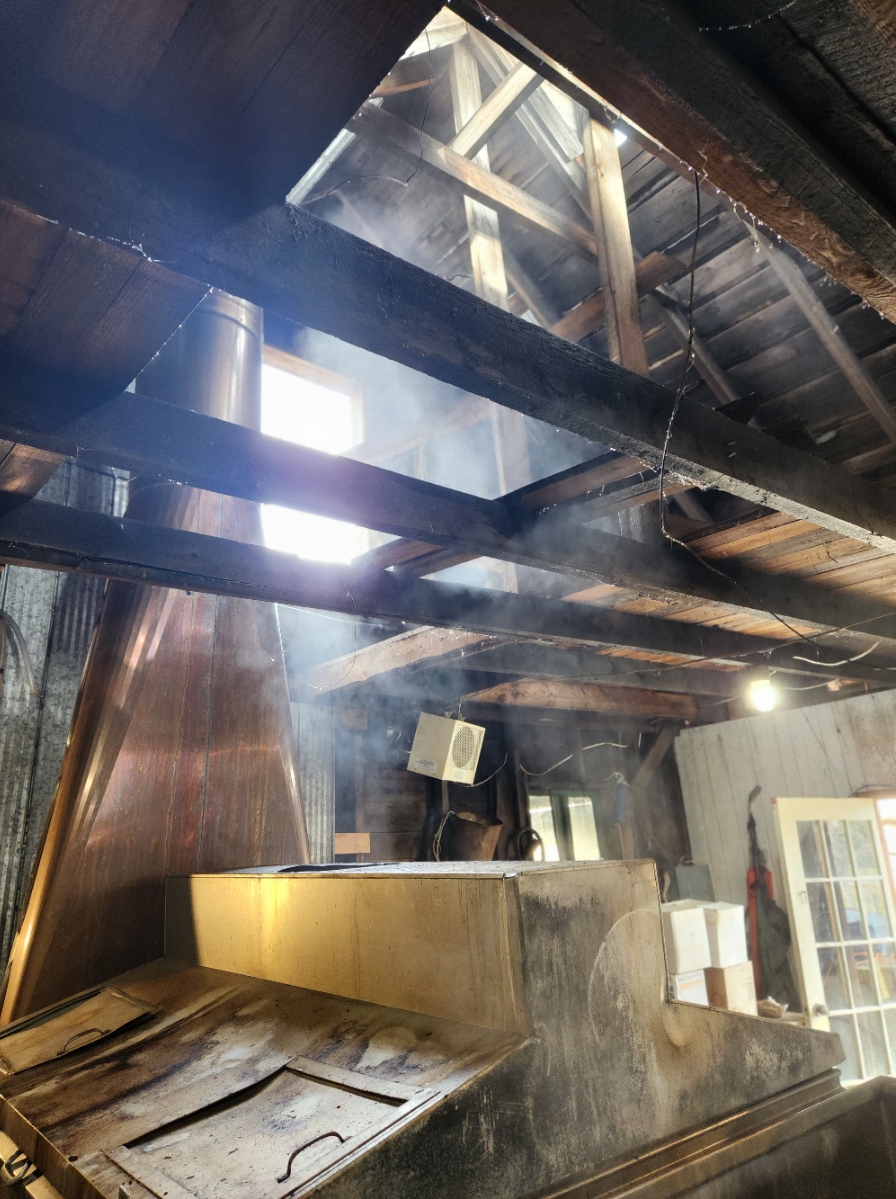
 the Holmes Round Barn
Leave a comment