
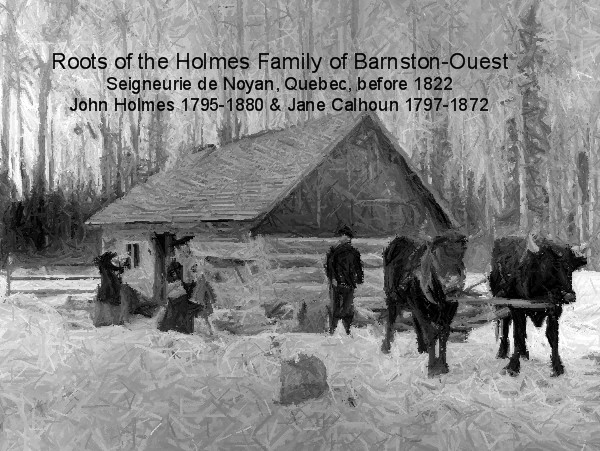
Welcome to the roots of the Holmes Family
The Canadian patriarch of this Holmes family in Barnston-Ouest is John Holmes who was born 1795 in Strabane, Tyrone County, Ireland. He married Jane Calhoun born in Ireland around 1797. John’s father remains a mystery at this point; however there does seem to be a possible connection to a Samuel Holmes of Glentown who died 16 Sep 1871. It appears that Rosanna Knox was his mother. Little is known about Jane Calhoun; but there is a Calhoun at that time in the area that was a lawyer.
Aunt Norma (1898-2001) wrote about this in her casual family history:
Samuel Holmes, from Strabane, County Tyrone, Ireland, came to the US, got homesick and returned to Ireland. Had a farm ‘way out in the country’ and raised a large family. One or two came to Philadelphia, the rest stayed in Ireland. I believe it is this line I met in Ireland.
Samuel’s brother, my great-great-great Grandfather married Rosanna Knox. A son, John married Jane Calhoun and had 8 children.
He was just a farmer in Strabane (or farmer’s son) and her people must have thought they were on a higher plane, because they disapproved of the match and disowned her. So, they ran away and came to Canada. They came with all their belongings in a springless wagon to Philipsburg and settled on a little 10-acre place near Pike River.
The Seigneurie de Noyan
Although, they might have settled near Pike River in the beginning, the first official record of John Holmes in Canada was in the Noyan Seigneurie in 1854. Their arrival would have been before 1822 when son John was born.
One of the first areas to be settled in the Eastern Townships of Quebec was the Seigneurie de Noyan – a strip of land along the Richelieu River, divided into long narrow lots. After the British conquest, it passed on to Lieutenant-Colonel Gabriel Christie in 1764, whose estate actively recruited settlers; including Loyalists, Irish and British. By the early to mid 1800s the landscape was a patchwork of partly cleared farms, wooded back lots, and small riverfront clearings tied to mills, churches and rough roads.
Their home was a classic long lot – part of lot 2, concession 2 – 55 acres total, with just 2 acres frontage on the river. This old French land system meant they rented from the seigneur but worked the soil themselves.
Quebec officially ended the Seigneurial system of land distribution in 1854. The Watson survey shows that John Holmes occupied this lot.
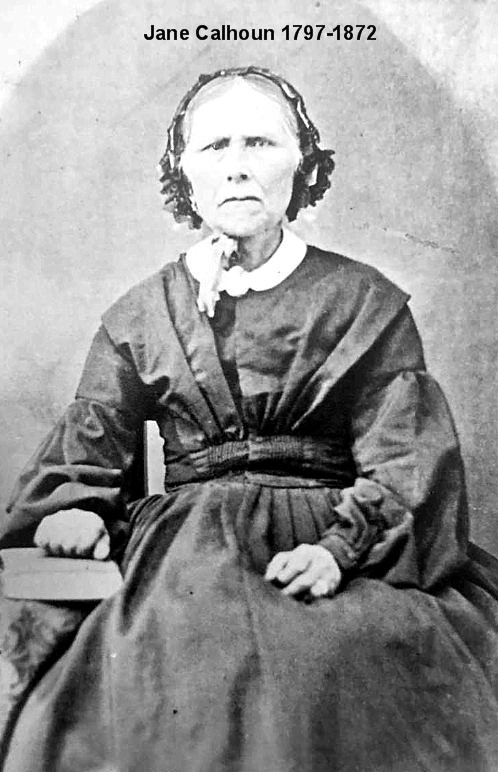
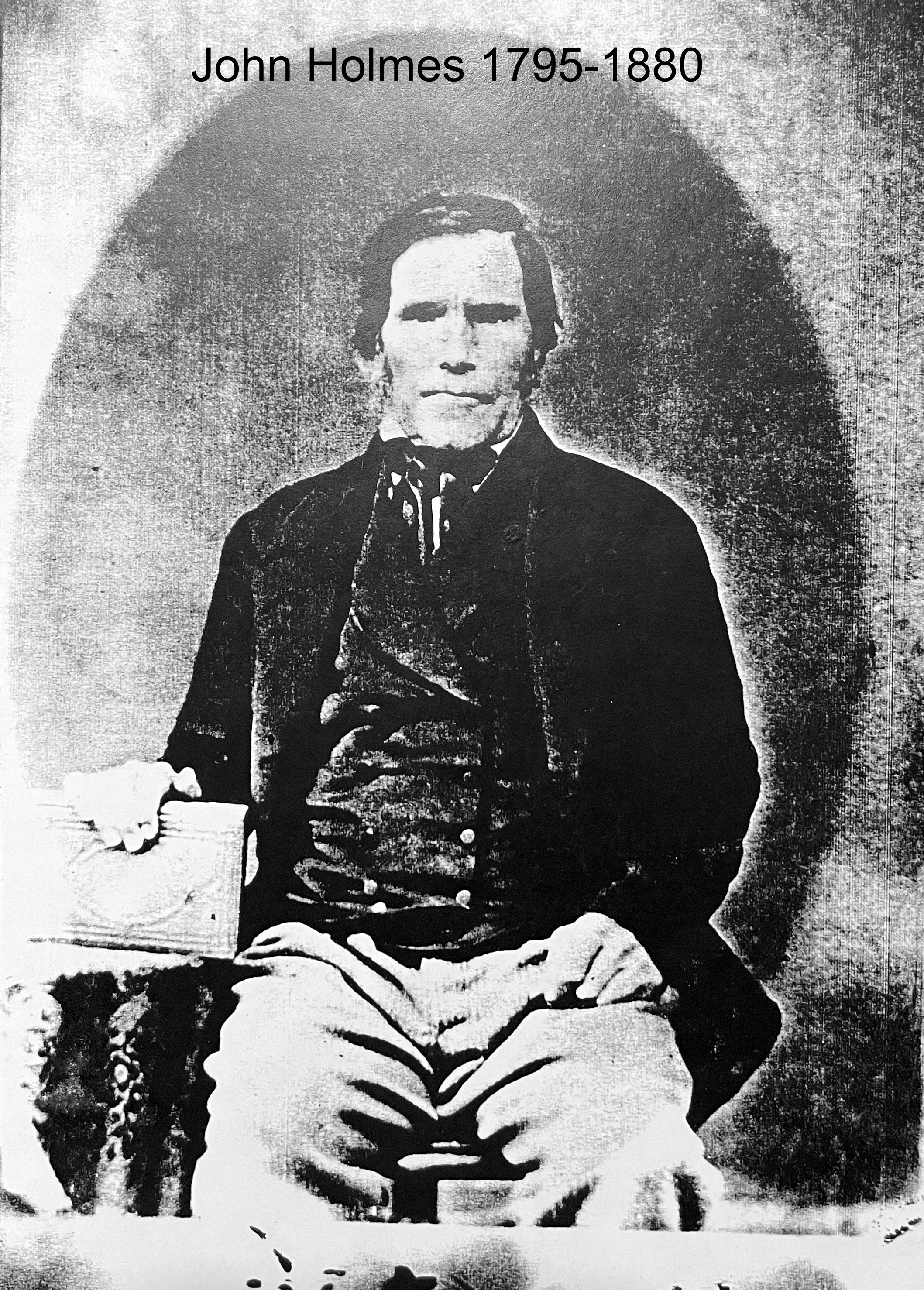
Family
Between about 1822 and 1842, John and Jane’s children were born in Noyan, anchoring the family firmly in the community.
- John (1822-1886 in Sutton) married Irish-born Agnes Allan at Noyan in 1852. Later moving to Sutton; children Mary Jane (1854), John Alexander (1856-1895) and Frances George (1858-1928).
- Francis (1829-about 1865), left for Mendicino County, California, became a sheep farmer and was murdered there.
- Eliza (1829-1892 Stanbridge) buried at Stanbridge Ridge Cemetery.
- Rosanah (1832- 1885 Stanbridge) Eliza and she had their own place for a time near Bedford, Que.
- Samuel (1832-1904 Erving, Mass.) married Jane Elizabeth Reed (1840-1924) in Sterling, Mass. Children were Burton Edward (1865-1866), Charles Herbert (1867-1946), Lena Luella (Redfearn)(1869-1940), Albert Wilton (1871-1958), Elbridge Reed (1876-1969).
- William (1836-1895, Stanbridge) married Esther Victoria Corey (1836-1919) at Frelighsburg Baptist Church in 1856; their children include Almeda Jane (1857-1942), Marie Louise (1859-1877), Francis Irving (1860-1882), Esther Sophia (1863-1863), Denton I. (1864-1864), William Henry (1865-1955), Esther Victoria (1869-1948), Clayton Vincent (1870-1876), Clinton Vernon (1870-1877) and Ethel Cora (1878-1968).
- Jane (1839-1928 Sutton, Que.) married David Carl Officer (1842-1929) in Sterling, Mass. 1864; children William Edward (1866), James Edwin (1867-1949), Eliza Jane (1871), Mary Annette (1873), Arthur (1875), Sadie Victoria (1883).
- James (1844 in Noyan) Went to the US, not much is known about him.
John died in 1880 in Stanbridge East and Jane in 1872; both rest at Stanbridge Ridge Cemetery (after their reinterment from the Corey family cemetery), tying their life story directly from Richelieu-side Noyan into the Protestant heartland of Missisquoi and the Eastern Townships.
Daily life on the Holmes Farm
In the early 1800s, John Holmes and his Ulster-Protestant family settled on Concession 2, part lot 2, along the Richelieu River, carving out a hardscrabble life amid dense woods and frontier demands.
They would have started with a rough log shanty for shelter, soon upgrading to a sturdy frame house warmed by a wood stove, stocked with simple furniture and their cherished family Bible, plus outbuildings for cows, pigs, and poultry. John and his sons hacked at the forest daily, burning stumps to open long, narrow fields stretching from riverfront to backwoods for wheat, oats, barley, and potatoes, gradually mixing in dairying like other local farmers.
As censitaires under the Christie estate, they paid modest yearly dues, ground grain at the seigneur’s mill for a cut, and pitched in for occasional road or bridge corvées—though enforcement stayed loose on this raw edge of the seigneury.
The Richelieu River served as both highway and lifeline, allowing the family to move produce, access markets and mills and travel to worship or to nearby communities.
Religion
Irish Protestants in Noyan formed part of an English-speaking cluster along the Richelieu and in neighbouring Caldwell Manor and Missisquoi. They worshipped primarily in Anglican or related Protestant congregations serving Irish, Scots, English, Loyalists and American settlers – churches such as St. Thomas and other local parishes documented for the region.
This identity meant Sunday travel to English-language services for worship, sacraments and community gatherings. A social world centered on the church – marriages, baptisms, funerals and seasonal events – which knit together Holmes, Allan, Corey, Officer and other local families into a coherent network. Although John is listed as Presbyterian in a census, their family shows events occurring in a variety of Protestant denominations, including Anglican, Baptist and Methodist, reflecting a diverse denominational background.
This religious and cultural framework followed the family when some children moved into Sutton and Stanbridge and when Samuel and Jane carried it to Sterling, Massachusetts.
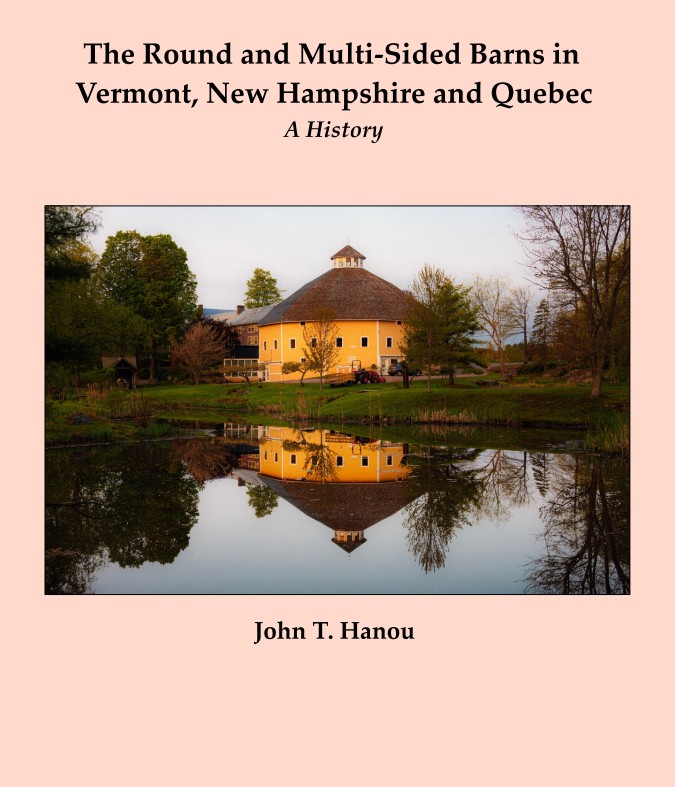
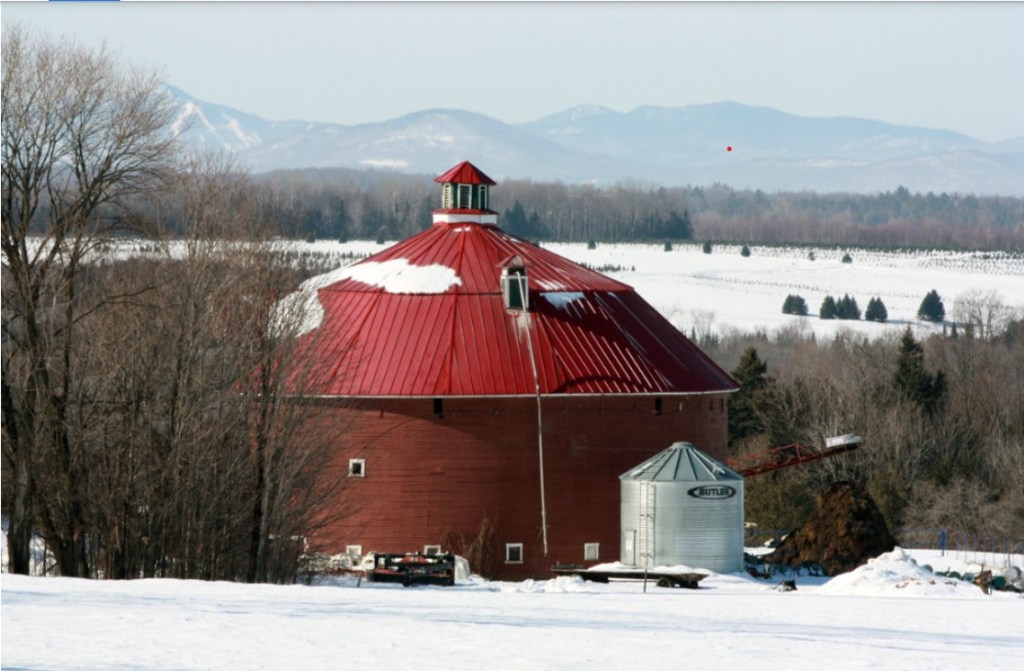
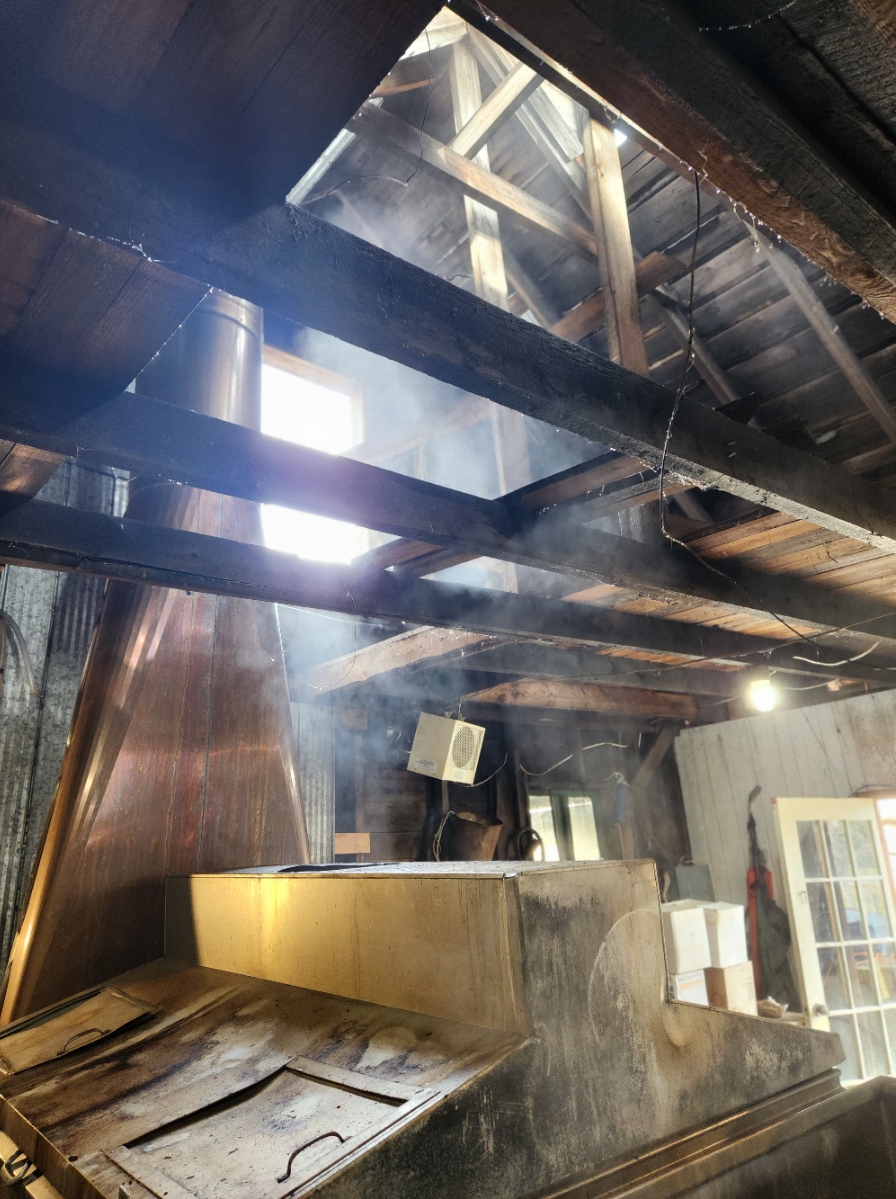
 the Holmes Round Barn
Leave a comment